 |


|




Emergence of the MiG-23 and -25 in 1967 accentuated the belief of the US Air Force that it was
falling behind in true fighter aircraft. McDonnell's team at St. Louis was quickly developing
 a new air-superiority fighter, the FX. The Air Force funded a new engine, developed by Pratt &
Whitney, and a new 25mm gun using caseless ammunition (eventually abandoned after problems with
development). Thus the Eagle emerged as probably the best fighter in the world,
with thrust at low levels considerably greater than clean gross weight, a fixed wing of
no less than 530 sq ft area, a single seat, and an advanced Hughes X-band pulse-doppler
a new air-superiority fighter, the FX. The Air Force funded a new engine, developed by Pratt &
Whitney, and a new 25mm gun using caseless ammunition (eventually abandoned after problems with
development). Thus the Eagle emerged as probably the best fighter in the world,
with thrust at low levels considerably greater than clean gross weight, a fixed wing of
no less than 530 sq ft area, a single seat, and an advanced Hughes X-band pulse-doppler
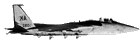
 radar. The single-seat F-15C and two-seat F-15D models entered the Air Force
inventory beginning in 1979. Kadena Air Base, Japan, received the first
F-15C in September 1979. These new models have Production Eagle Package
(PEP 2000) improvements, including 2,000 pounds (900 kilograms) of additional internal
fuel, provision for carrying exterior conformal fuel tanks and increased maximum takeoff
weight of up to 68,000 pounds (30,600 kilograms).
radar. The single-seat F-15C and two-seat F-15D models entered the Air Force
inventory beginning in 1979. Kadena Air Base, Japan, received the first
F-15C in September 1979. These new models have Production Eagle Package
(PEP 2000) improvements, including 2,000 pounds (900 kilograms) of additional internal
fuel, provision for carrying exterior conformal fuel tanks and increased maximum takeoff
weight of up to 68,000 pounds (30,600 kilograms).
Though planned as an uncompromised machine for interception and air combat, the Eagle also
 has formidable attack capability over intercontinental ranges. It is an all-weather, extremely maneuverable, tactical fighter
designed to gain and maintain air superiority in aerial combat. Undoubtedly, it's
chief attributes are its combay manoeuvrability (it can outfly almost any other US fighter
without using afterburner), and the advanced automaticity of its radar, HUD, weapon selectors,
and quick-fire capability. Internal fuel capasity of 11,200lbs can can be almost doubled by
has formidable attack capability over intercontinental ranges. It is an all-weather, extremely maneuverable, tactical fighter
designed to gain and maintain air superiority in aerial combat. Undoubtedly, it's
chief attributes are its combay manoeuvrability (it can outfly almost any other US fighter
without using afterburner), and the advanced automaticity of its radar, HUD, weapon selectors,
and quick-fire capability. Internal fuel capasity of 11,200lbs can can be almost doubled by
 adding a FAST PACK (fuel and sensor, tactical package) extrenally on each side of the fuselage, allowing the aircraft
to carry and extra 10,000lbs of fuel and target designators or weapons. Without compromising the primary
air-to-air combat role, the aircraft is capable of performing a secondary air-to-ground missions with
few modifications needed. A multimission avionics system sets the F-15 apart from other fighter
aircraft. It includes a head-up display, advanced radar, inertial navigation system, flight
adding a FAST PACK (fuel and sensor, tactical package) extrenally on each side of the fuselage, allowing the aircraft
to carry and extra 10,000lbs of fuel and target designators or weapons. Without compromising the primary
air-to-air combat role, the aircraft is capable of performing a secondary air-to-ground missions with
few modifications needed. A multimission avionics system sets the F-15 apart from other fighter
aircraft. It includes a head-up display, advanced radar, inertial navigation system, flight
 instruments, UHF communications, tactical navigation system and instrument landing system. It
also has an internally mounted, tactical electronic-warfare system, "identification friend or
foe" system, electronic countermeasures set and a central digital computer.
The Eagle can be armed with combinations of four different air-to-air
weapons: AIM-7 Sparrow missiles or the AIM-120 Advanced Medium Range Air-to-Air Missiles
on its lower fuselage hardpoints, AIM-9L/M Sidewinder or AIM-120 missiles on two pylons under
instruments, UHF communications, tactical navigation system and instrument landing system. It
also has an internally mounted, tactical electronic-warfare system, "identification friend or
foe" system, electronic countermeasures set and a central digital computer.
The Eagle can be armed with combinations of four different air-to-air
weapons: AIM-7 Sparrow missiles or the AIM-120 Advanced Medium Range Air-to-Air Missiles
on its lower fuselage hardpoints, AIM-9L/M Sidewinder or AIM-120 missiles on two pylons under
 the wings, and an internal 20mm Gatling gun (with 940 rounds of ammunition) in the right
wing root.
the wings, and an internal 20mm Gatling gun (with 940 rounds of ammunition) in the right
wing root.
Very extensive electronic systems for attack and defence, far beyond any standard previously seen in a fighter are carried. In 1975, unit cost of $7.5mil/unit had been more than doubled in 1976 to $16.7mil/unit. The original order of 729 aircraft would cost the US some $12.2 billion.
F-15C's, D's and E's in the 1991 Persian Gulf conflict in support of Operation Desert Storm proved their superior combat capability with a confirmed 26:0 kill ratio.
Top| F-15 Eagle | |
|---|---|
| Manufacturer: | McDonnel Douglas |
| Year Deployed: | July 1972 |
| Crew: | F-15A/C: one. F-15B/D: two |
| Engines: | Two Pratt & Whitney F100-220 Afterburning Turbofans |
| Speed: | 1,875 mph (Mach 2.5) |
| Length: | 63' 9" (19.43 meters) |
| Height: | 18' 8" (5.69 meters) |
| Wingspan: | 42' 10" (13.06 meters) |
| Max Weight: | 68,000 lbs (30,600 kg) |
| Range: | 3,450 miles (3,000 nautical miles) |
| Cost: | $15 million |
| No. in Service: | - |
| Armorment: | One M-61A1 20mm multibarrel gun with 940 rounds of ammunition, four AIM-9L/M Sidewinder and four AIM-7F/M Sparrow missiles, or a combination of AIM-9L/M, AIM-7-F/M and AIM-120 missiles. |


