 |


|






Despite the more overt attractions of Mach 2 aircraft the US Air Forces were forced to
consider the CAS (close air support) mission because of the total unsuitability of its
existing equipment. In both the Korean and Vietnam war, its aircraft had been worldbeaters
but planned for a totally different kind of war. What has needed, it appeared, was something
 like and up-to-date Skyraider that could carry a heavy load of ordinance, had good endurance
and could survive severe damage from ground fire. Between 1963 and 1969 extensive studies
gradually refined the AX specification, which had begun by presupposing a twin turbo prop
and ended with a larger aircraft powered by two torbofans. After an industry-wide competition
the Northop A-9A and the Fairchild A-10A were chosen for prototype fly-off evaulation, which
took place with two of each type at Edwards AFB in oct 1972. The A-10 was the winner and
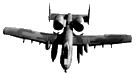
by 1975, the Air Force took its first delivery of the Thunderbolts. The Thuderbolt had
undergone minor revisions since, with the Thunderbolt II having more up to date electronics
and slight modifications in structural design and payload layout.
like and up-to-date Skyraider that could carry a heavy load of ordinance, had good endurance
and could survive severe damage from ground fire. Between 1963 and 1969 extensive studies
gradually refined the AX specification, which had begun by presupposing a twin turbo prop
and ended with a larger aircraft powered by two torbofans. After an industry-wide competition
the Northop A-9A and the Fairchild A-10A were chosen for prototype fly-off evaulation, which
took place with two of each type at Edwards AFB in oct 1972. The A-10 was the winner and
by 1975, the Air Force took its first delivery of the Thunderbolts. The Thuderbolt had
undergone minor revisions since, with the Thunderbolt II having more up to date electronics
and slight modifications in structural design and payload layout.
General Electric the winner of the contest to produce the 30mm tank-busting cannon, the
 most powerful ever fitted to any aircraft, with a very high muzzle velocity and rate of
fire. This gun is considered the main weapon on the A-10. Muzzle horsepower was 20x
that of the 75mm gun fitted to some B-25s in WWII. Named the Avenger Cannon, this
7-barreled gatling gun is driven hyraulically at either 2,100 or 4,200 rounds per min and
is fed by a drum containing 1,350 rounds (weighing approx 3820lbs). Rounds are each
a pound and a half in weight, a foot long and fired at a rate of approx 65 rounds per
second. The shells are able to penetrate up to 4 inches of tank armor, thus the origin of
it's first nickname, "tank killer". Empty cases are fed back to the rear of the drum. By
1978, ground reloading was made automatic by a specially designed reloading system.
Currently, the gun used is a slight variant of the original, the GAU-8/A Avenger 30mm
gatling gun. The accuracy of this cannon is exceedingly good, with over 80% of projectiles
fired from over a mile away impact within a 30 foot radius. Projectiles fired can be of
three types - Target Practice (TP) round, the Armor Piercing Incendiary (API) round, and
most powerful ever fitted to any aircraft, with a very high muzzle velocity and rate of
fire. This gun is considered the main weapon on the A-10. Muzzle horsepower was 20x
that of the 75mm gun fitted to some B-25s in WWII. Named the Avenger Cannon, this
7-barreled gatling gun is driven hyraulically at either 2,100 or 4,200 rounds per min and
is fed by a drum containing 1,350 rounds (weighing approx 3820lbs). Rounds are each
a pound and a half in weight, a foot long and fired at a rate of approx 65 rounds per
second. The shells are able to penetrate up to 4 inches of tank armor, thus the origin of
it's first nickname, "tank killer". Empty cases are fed back to the rear of the drum. By
1978, ground reloading was made automatic by a specially designed reloading system.
Currently, the gun used is a slight variant of the original, the GAU-8/A Avenger 30mm
gatling gun. The accuracy of this cannon is exceedingly good, with over 80% of projectiles
fired from over a mile away impact within a 30 foot radius. Projectiles fired can be of
three types - Target Practice (TP) round, the Armor Piercing Incendiary (API) round, and
 the High Explosive Incendiary (HEI) round.
Underwing stores can be comprised of any of the Tactical Command inventory on 11 available pylons, 4 under each wing, and 3 under the main fuselage.
Uniquely, when retracted, the landing gear produde enough to allow for a damage free emergency
landing. All tail surfaces are interchangeable, the cockpit is enclosed in a shell
of titanium armour, and the engines are hung above the fuselage where infra-red signatures
are at a minimum. The redundant primary structural sections allow the aircraft to
survive direct hits from armor-piercing and high-explosive projectiles up to 23mm.
Their self-sealing fuel cells are protected by internal and external foam-producing fire
control systems. The A-10's redundant hydraulic flight-control systems are backed up
by manual systems allowing pilots to fly and land even when hydraulic power is lost. The
 ACES II ejection seat system provides a "zero-zero" capability (zero velocity and zero
altitude) either with the canopy removed or through the canopy.
The toughness of this plane is staggering, thus earning it's nickname - "the Warthog".
Upwards of 735 of these planes were ordered from Fairchild by the mid-seventies, with an
evenutal inventory of 721 planes being produced. Still in active duty with 317 planes,
older retired and modified A-10s are used in firefighting efforts where they can carry
heavy loades of water, or deploy smoke jumpers over a forest fire.
ACES II ejection seat system provides a "zero-zero" capability (zero velocity and zero
altitude) either with the canopy removed or through the canopy.
The toughness of this plane is staggering, thus earning it's nickname - "the Warthog".
Upwards of 735 of these planes were ordered from Fairchild by the mid-seventies, with an
evenutal inventory of 721 planes being produced. Still in active duty with 317 planes,
older retired and modified A-10s are used in firefighting efforts where they can carry
heavy loades of water, or deploy smoke jumpers over a forest fire.
The Thunderbolts were essential in the Gulf War, had a mission capable rate of 95.7%, flew 8,100 sorties and launched 90% of the AGM-65 Maverick missiles.
Top| A-10 Thunderbolt II | |
|---|---|
| Manufacturer: | Fairchild Republic Co. |
| Year Deployed: | March 1976 |
| Crew: | 1 |
| Engines: | Two General Electric TF34-GE-100 turbofans |
| Speed: | 420 mph (mach 0.56) |
| Length: | 53' 4" (16.2 meters) |
| Height: | 14' 8" (4.4 meters) |
| Wingspan: | 57' 6" (17.4 meters) |
| Max Weight: | 51,000 pounds (22,950 kilograms) |
| Range: | 800 miles (695 nautical miles) |
| Cost: | $8.8 Million |
| No. in Service: | 274 (max of 721) |
| Armorment: | One 30 mm GAU-8/A seven-barrel Gatling gun; up to 16,000 pounds (7,200 kilograms) of mixed ordnance on eight under-wing and three under-fuselage pylon stations, including 500 pounds (225 kilograms) of retarded bombs, 2,000 pounds (900 kilograms) of general-purpose bombs, incendiary and Rockeye II cluster bombs, combined effects munitions, Maverick missiles and laser-guided/electro-optically guided bombs, infrared countermeasure flares, electronic countermeasure chaff, jammer pods, 2.75-inch (6.99 centimeters) rockets, illumination flares and AIM-9 Sidewinder missiles. |


